

The Hidden Pattern in Every Economic Collapse

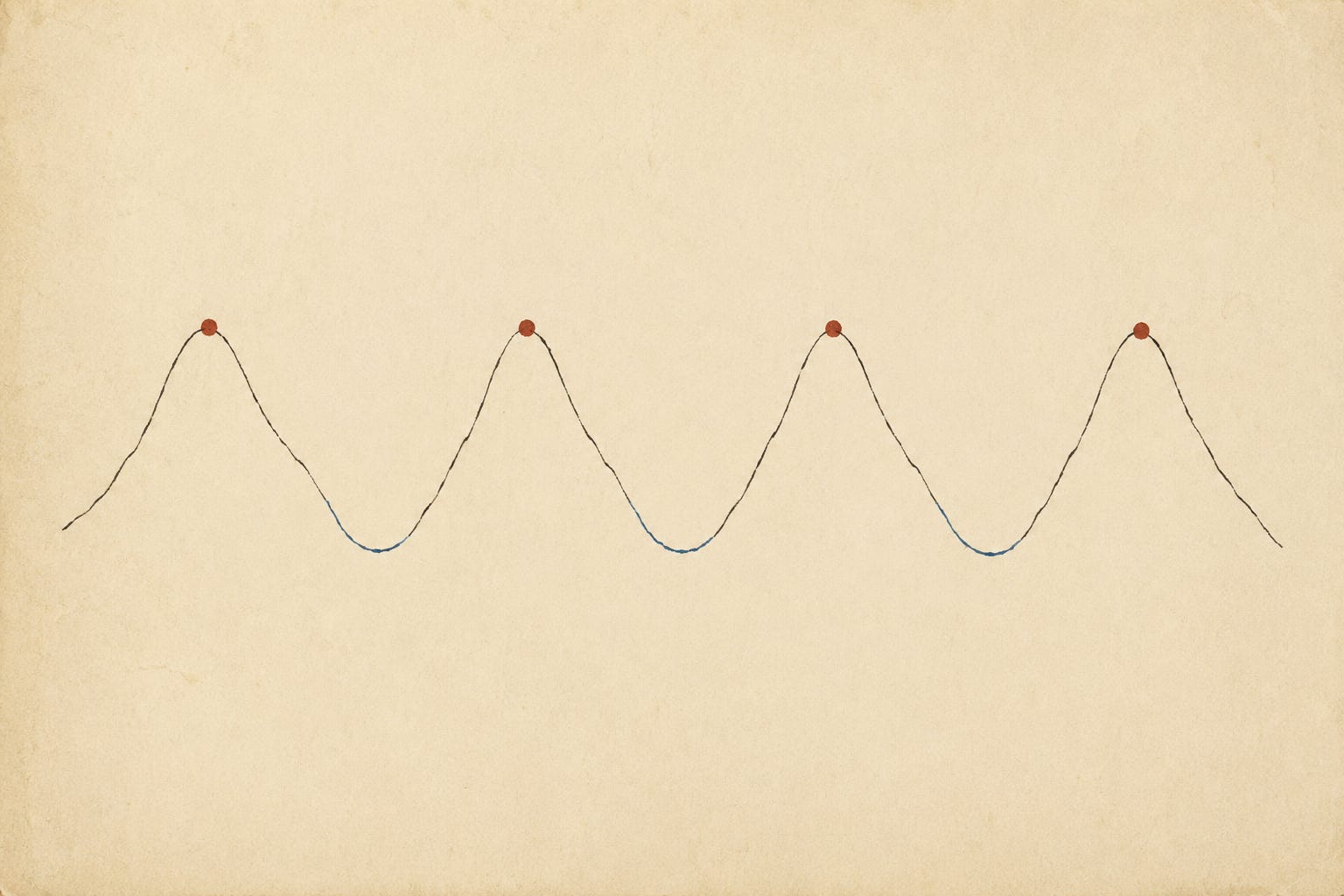
Collapse is usually remembered as a date. The Wall Street crash of October 1929, the fall of Lehman Brothers in September 2008, the bursting of the dot-com bubble in the spring of 2000. We fix on the moment the floor gives way because it is dramatic and easy to narrate, and because a single date lets us treat the catastrophe as an accident, something that arrived from outside and could not have been seen coming. The people who study these events closely tend to arrive at the opposite impression. What looks like a sudden rupture is almost always the last movement of a long and surprisingly orderly sequence, one that recurs across centuries and across economies that otherwise share almost nothing. The same four phases appear again and again. A period of real growth gives way to a period of denial about what that growth has become, which slides into a decline that feels at first like ordinary turbulence, and ends in a renewal that is slower and stranger than anyone expects. Learning to recognise the shape of that sequence does not make a person immune to it, but it changes what collapse means, and what it asks of us while we are still living inside it.
Growth, and the moment it changes character
Every cycle begins with something real. The railway mania of the 1840s was built on an invention that did, in fact, transform the movement of goods and people. The electrification of the early twentieth century, the personal computer, the early and sober years of mortgage finance: each rested on a genuine expansion of what an economy could do. This is worth holding onto, because the temptation after a collapse is to dismiss the whole episode as a delusion from the start, and it rarely was. The trouble begins later, at the point where growth stops being understood as a means to something and starts to be treated as an end in itself, almost as a faith.
Charles Kindleberger, whose history of financial crises remains the closest thing the field has to a field guide, called the opening move a displacement: some real change in the world, a new technology or a new market, that opens a credible story about future wealth. The story is true enough to draw money in, and the money draws in more money, and somewhere in that process the original logic quietly inverts. People stop buying because they believe in the thing and start believing in the thing because everyone is buying. A society in this phase loses its ability to tell the difference between growth and good. When that distinction goes, the turn has already begun, even though, from the inside, the mood is one of confidence rather than alarm.
Denial, dressed as sophistication
The most reliable feature of the second phase is that it does not feel like denial. It presents itself as maturity, as the considered recognition that the old rules have been superseded by new conditions. Carmen Reinhart and Kenneth Rogoff gave their study of eight centuries of financial folly the title This Time Is Different, because that single sentence, in one form or another, precedes almost every crisis on record. The technology is unprecedented, so the old valuations no longer apply. The central bank has finally tamed the business cycle. The housing market has never fallen nationwide, so it never will. Each claim contains a fragment of truth, which is precisely what makes it persuasive, and each functions to explain away the evidence that the cycle is doing what it has always done.
The economist Hyman Minsky offered the deepest account of why this happens, and it is uncomfortable because it locates the cause in success rather than in greed. Stability, he argued, is destabilising. A long stretch of calm teaches people that risk has been conquered, and so they take on more of it, borrowing against assets whose prices only ever seem to rise, until the system is balanced on a structure of debt that requires the good times to continue indefinitely. The behaviour that produces the fragility is, at every individual step, entirely rational. J.K. Galbraith caught the human texture of the same period in his history of 1929, with his idea of the bezzle, the swelling inventory of undiscovered fraud and self-deception that accumulates while confidence is high and that only comes to light once the mood turns. In the boom, no one wants to count it. In the bust, it is suddenly everywhere.
Decline, which arrives as exhaustion
The third phase is the one we name when we say the word collapse, and yet it is the phase we understand least, because it almost never resembles the cinematic image of a market falling off a cliff in an afternoon. There is a line in Hemingway, asked how a character went bankrupt, that captures it better than any economic model: gradually, and then suddenly. The gradual part is the part that matters, and it is the part we tend to forget. Long before the crash that makes the history books, there is a slow accumulation of strain that registers as a series of tolerable adjustments. A firm delays an investment. A household refinances. A bank quietly tightens a lending standard it had loosened the year before. None of these moments announces itself as the beginning of the end, and each is survivable on its own, which is exactly why the decline is so hard to read while it is underway.
What we experience, in this phase, is less like destruction and more like fatigue. The institutions still function. The shops are open and the lights are on. The crisis becomes ambient, a background condition that people adapt to one inconvenience at a time, until the cumulative weight of all those small adjustments finally exceeds what the structure can bear, and the sudden part of Hemingway’s line takes its turn. By then the actual trigger, whichever overleveraged firm or mispriced asset happens to give way first, is almost incidental. It is treated afterwards as the cause, but it was only the place where the accumulated pressure found its release.
Renewal, which is not redemption
The fourth phase is the one our stories handle worst, because we want it to be either a tragedy or a resurrection, and it is reliably neither. Systems fail; the people inside them carry on, and out of that carrying on something new is assembled. After 1929 came the wave of regulation that separated commercial from investment banking and built the architecture of deposit insurance. After the wreckage of the 1970s came a wholesale rethinking of monetary policy. After 2008 came a decade of reform aimed at the leverage and opacity that had done the damage. Renewal in the economic sense is mostly this: the slow, contested, deeply political work of building rules for the failure that just happened, rather than for the one that comes next.
It is worth being honest about how partial this is. The reforms that follow a collapse are written by the survivors of the last crisis, which means they are always fighting the previous war, and the conditions they create often plant the seeds of the following cycle. The separation of banks erected after 1929 was dismantled by the end of the century, in time for the next expansion to make use of the freedom. Renewal, in other words, is not the end of the pattern but the beginning of its repetition, which is the part that can make the whole thing feel hopeless. I would resist that conclusion. The fact that the cycle returns does not mean nothing was learned, only that learning in human systems is never permanent and has to be done again by each generation that inherits the calm.
Reading the cycle we are in
The value of recognising the pattern is not that it lets anyone time a crash, which remains close to impossible, but that it offers orientation. If collapse is a sequence rather than an event, then there is always a question worth asking, which is not whether the system will fail but where in the sequence we currently stand. Has growth quietly become an article of faith that it is impolite to question? Are the explanations for why this time is different multiplying? Is the strain showing up as a run of small, reasonable adjustments that no one is connecting to one another? These are not questions a model can answer, but they are questions a thinking person can hold, and holding them changes how the noise of any given week is received.
History offers perspective rather than prophecy. It cannot tell us when the floor will give way, and it should make us sceptical of anyone who claims it can. What it can do is loosen the grip of the two responses that the third phase tends to produce, the denial that insists nothing is wrong and the panic that insists everything is lost, both of which are forms of refusing to look. Between them sits the quieter possibility of simply seeing the shape of the thing clearly, which is the one position from which it is still possible to act well. The cycle has run many times before. We are somewhere inside another turn of it now, and the most useful thing is not to predict the ending but to understand, with as little flinching as possible, the part we are living through.